
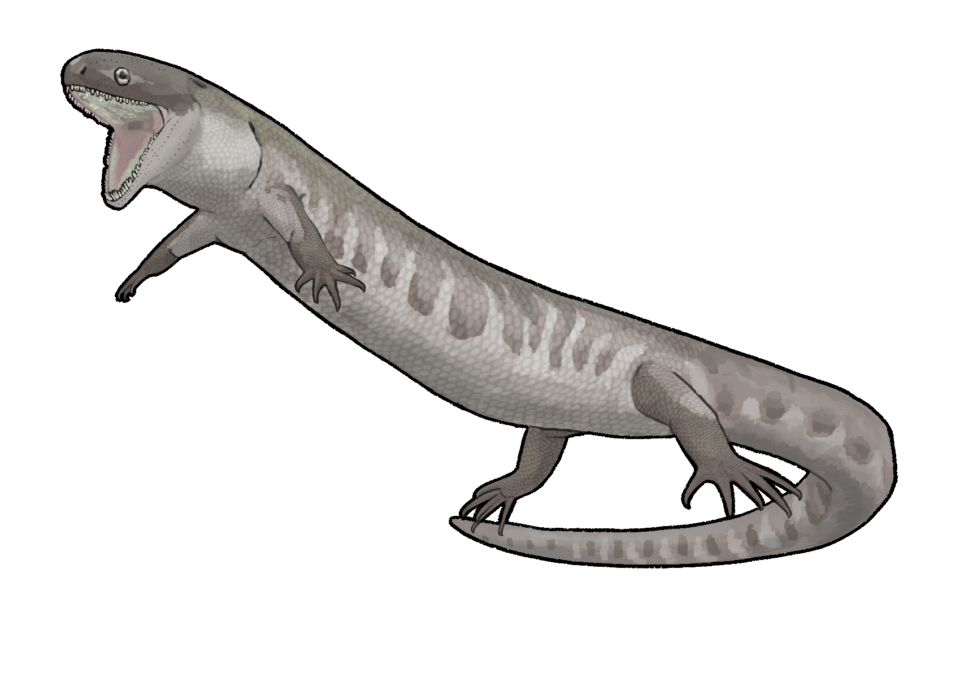
A tiny fossil nicknamed “Lizzie” just turned science on its head — and the discovery was led by New York’s own American Museum of Natural History. For nearly 30 years, Westlothiana lizziae, a 345-million-year-old fossil from Scotland, was celebrated as one of the earliest reptiles ever found: a landmark in the story of how vertebrates conquered the land.
A new study published in Nature, led by the AMNH and the University of Oxford together with the European Synchrotron Radiation Facility, reveals Lizzie was no reptile at all. Using powerful X-ray scans to peer inside the crushed fossil slabs, researchers uncovered hidden gills, a primitive skull, and a fish-like mouth lined with thousands of tiny teeth — the anatomy of an animal that lived in or around water, long before vertebrates settled permanently on land.
The surprises kept coming: clawed toes and weight-bearing forelimbs, traits long thought to belong only to land-adapted animals, had already evolved in watery ancestors. Co-lead researcher Xavier Jenkins of the Museum’s Division of Paleontology explains that these features accumulated piece by piece in animals still living “in and out of the water.”
It is a classic tale of science getting better with time — and of a New York museum at the center of an international team rewriting one of the most famous chapters of evolutionary history.
Illustration: Jacob Schick, via Wikimedia Commons (CC BY 4.0)