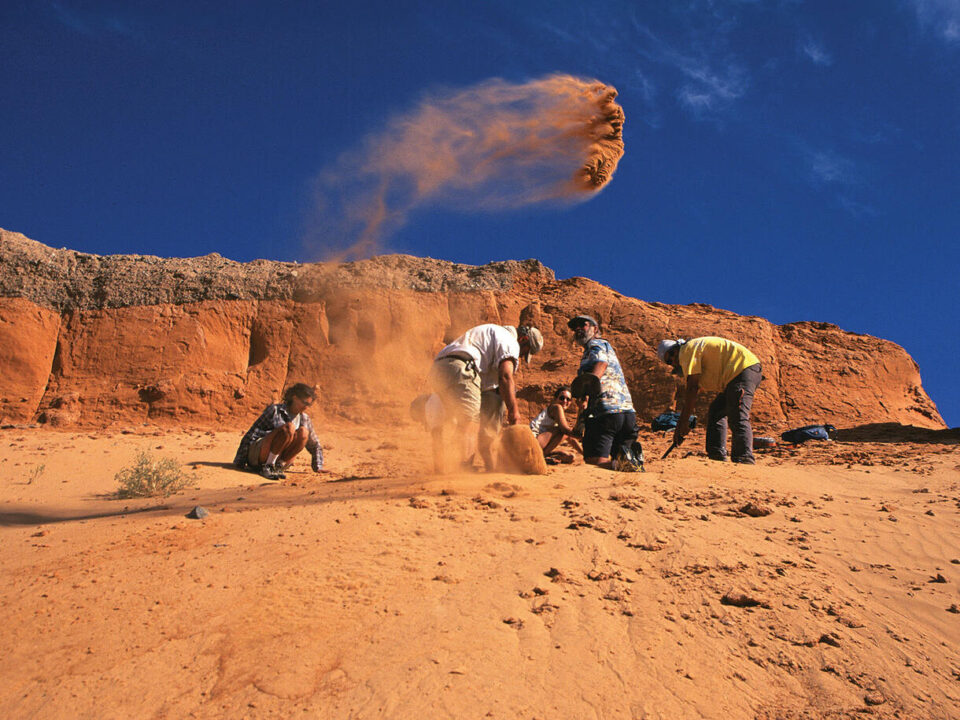
The American Museum of Natural History is inviting New York families on a 100-year adventure through the sands of Mongolia. Fossils of the Flaming Cliffs, now open on the Museum’s fourth floor, celebrates a century of fossil excavations in the Gobi Desert — one of the most extraordinary fossil landscapes on Earth.
Through dramatic large-scale photography and real fossil casts plus 3-D prints of landmark discoveries, visitors can see what Museum scientists have been uncovering for generations: beautifully preserved dinosaurs, lizards and early mammals that transformed our understanding of ancient life. One of the stars of the show is a cast of a dinosaur nest with a tiny just-hatched baby dinosaur at its center — proof that even the mightiest creatures started small. Twelve casts and prints are on view, including two toothless-beaked oviraptorid dinosaurs and a skeleton of an early mammal with a lifestyle similar to modern rodents.
The story begins in the 1920s, when the Museum’s team led by legendary explorer Roy Chapman Andrews discovered the first nests of dinosaur eggs at the Flaming Cliffs — the first clear evidence of how dinosaurs reproduced. A century later, Museum expeditions continue to dig there, and the adventure still brings dust, discovery and joy.
The exhibition also celebrates the memory of beloved paleontologist Mark Norell, who helped lead the Museum’s modern Gobi expeditions. Best of all: it’s included with any Museum admission, so a single visit delivers the dinosaurs and the whole Museum experience.
Photo: AMNH