
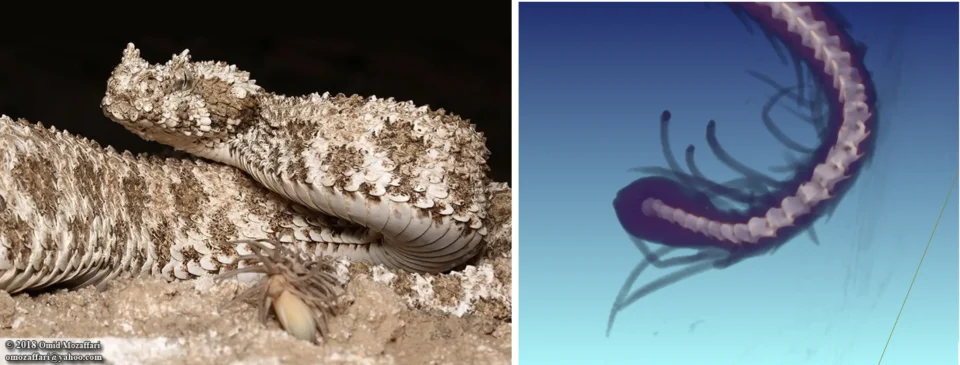
Nature’s creativity never ceases to amaze — and Chicago scientists just revealed one of its cleverest tricks. Researchers at the Field Museum have taken the first-ever look inside the bizarre tail of the spider-tailed horned viper, a rare snake from Iran whose tail tip looks exactly like a spider.
When scientists first collected a specimen back in 1968, people at the museum thought the strange lump on its tail was a deformity. We now know better: the snake wiggles its spider-like tail tip to lure hungry birds within striking distance — one of the wildest examples of mimicry in the animal kingdom.
In a new study published in the journal The Anatomical Record, Field Museum researchers used XCT scanners to peek at the inner workings of this spidery tail. The surprise? Inside, the tailbones are bizarrely normal. The extraordinary spider illusion is all skin-deep — proof that evolution can build a masterpiece with surprisingly ordinary parts.
“Scientists first collected a specimen of this snake in 1968,” says Sara Ruane, the museum’s Associate Curator of Herpetology, who notes how far our understanding has come since those early days of head-scratching.
Another reminder that Chicago’s Field Museum keeps pushing the frontiers of discovery — one wonderfully weird snake at a time.
Photo: Omid Mozaffari / Field Museum.