
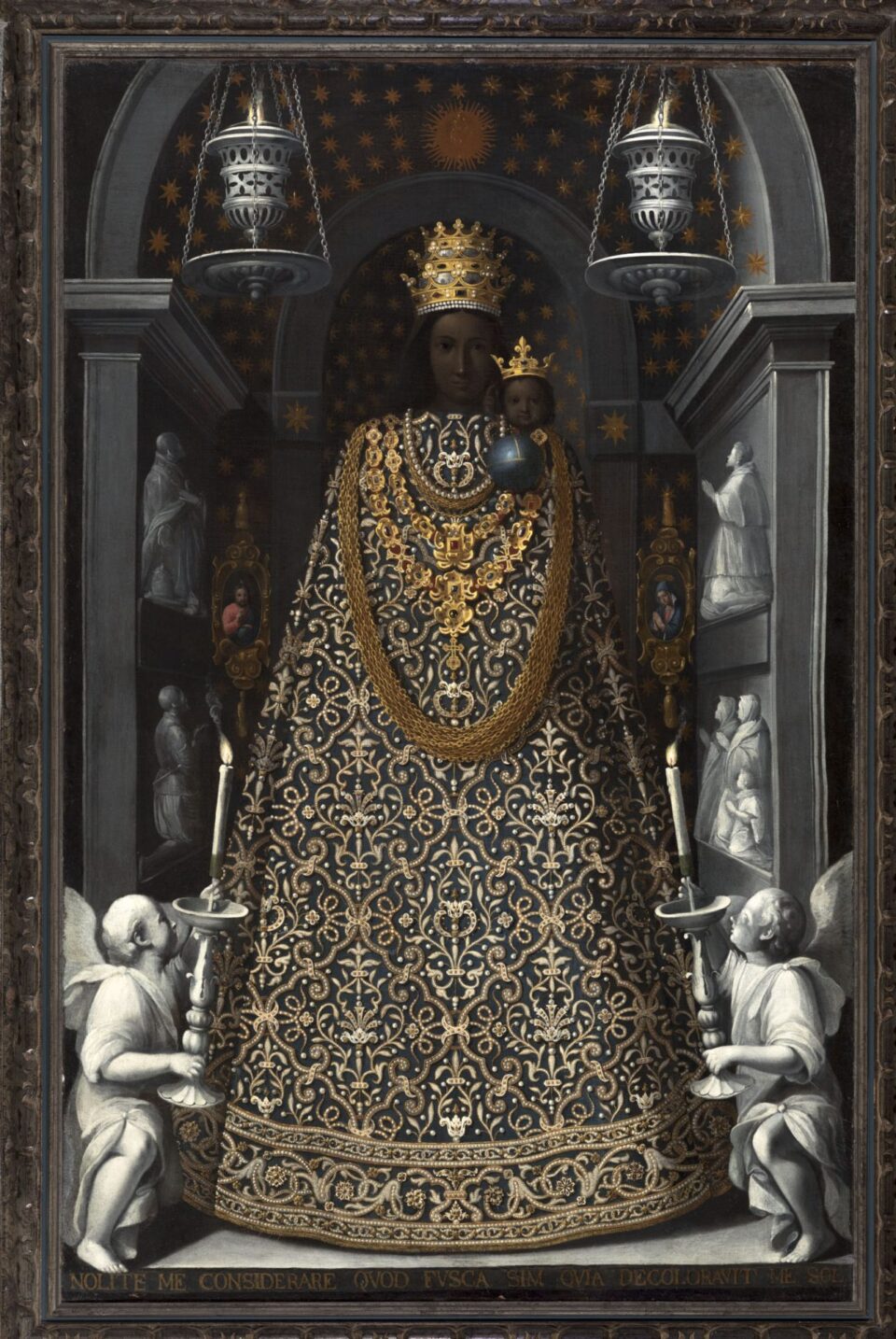
At the New Orleans Museum of Art, one painting stops visitors in their tracks: a monumental Madonna with a dark, luminous face, crowned in gold and wrapped in a gown of embroidered treasure, her crowned Child resting against her shoulder. For decades, the museum knew this striking canvas as Our Lady of Lima, a jewel of 17th- and 18th-century Peruvian viceregal painting.
Now, the artwork has reclaimed a whole new story. Recent scholarship by Italian art historians Chiara Marin and Maria Giulia Aurigemma uncovered a virtually identical painting in the sacristy of Rome’s Church of San Bernardo alle Terme, built in 1598. Their research revealed the true subject: Our Lady of Loreto, the beloved wooden statue venerated in Italy’s Holy House of Loreto — tradition says it was carved from an olive tree by St. Luke. Both scholars identify the theme as a signature subject of the Venetian artist Carlo Saraceni (c. 1579–1620), a master of dramatic light who worked in Rome.
NOMA acquired the canvas in 1970, when New Orleans was proudly calling itself the “Gateway to the Americas,” and the museum was building a collection celebrating Louisiana’s shared French and Spanish colonial history. The tradition of painting statues of the Virgin — the mamachas cherished across Peru — once flourished in Lima, until devastating earthquakes in 1687 and 1746 destroyed many of those works.
Today, you can stand before this golden mystery yourself at NOMA in City Park — a single painting that binds Rome, Peru, and New Orleans in one gaze. Plan your visit at noma.org.
Photo: New Orleans Museum of Art (NOMA)