
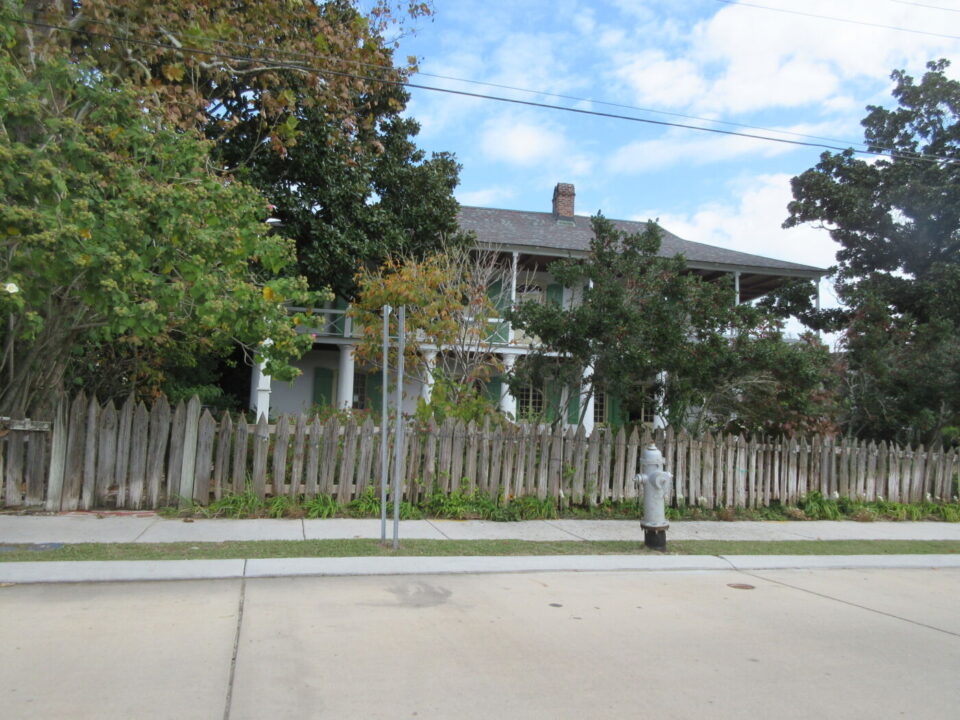
On the leafy banks of Bayou St. John stands one of New Orleans’ happiest survivals: the Pitot House, a circa-1799 Creole colonial country house that the Louisiana Landmarks Society opens to the public as a museum. It is the only Creole colonial country house open to the public in New Orleans, and one of the few colonial West Indies-style houses left in Louisiana.
The house carries famous names in its story. James Pitot, the first mayor of New Orleans after the city’s incorporation, lived here from 1810 to 1819; later, the Cabrini Sisters used the house as a convent. Preservationists saved and restored it, and today the Landmarks Society — caring for Louisiana’s historic places since 1950 — keeps its headquarters here.
Inside, the rooms are furnished with Louisiana and American antiques from the early 1800s through the mid-nineteenth century, telling the story of daily life along the bayou since the earliest days of settlement. Outside, a parterre garden in nineteenth-century style makes the grounds as lovely as the galleries.
The Pitot House, at 1440 Moss Street, welcomes visitors Wednesday through Sunday, with admission of $15 for adults and $12 for students, seniors and National Trust members. A tour here is a peaceful step back into the New Orleans of two centuries ago.
Photo: Wikimedia Commons