
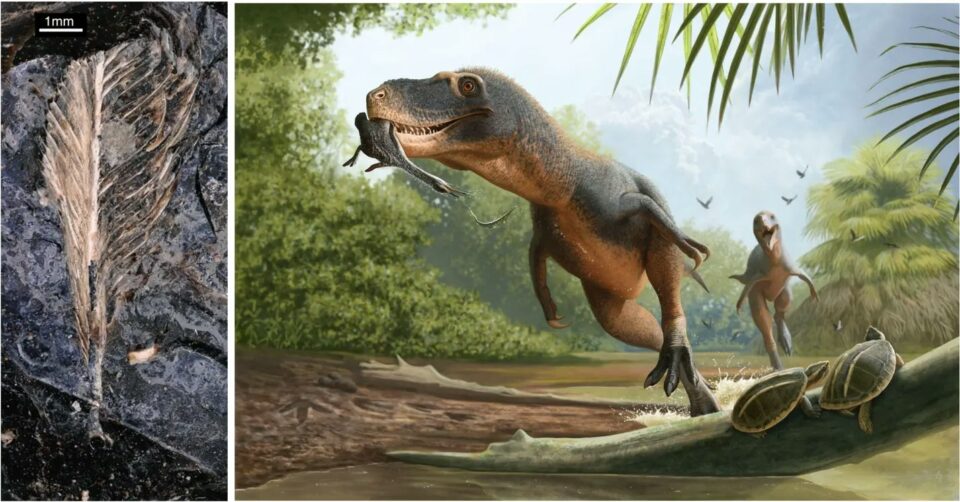
About 66 million years ago, somewhere in the ancient Midwest, a dinosaur — maybe a T. rex or a Nanotyrannus — ate a bird. The record of that meal, fossilized poop, has survived to today, and it holds the best-preserved feather ever found from the age of dinosaurs. A new study in the journal Current Biology reports that by studying this extraordinary feather, scientists have found clues to one of paleontology’s biggest questions: why are birds the only dinosaurs that survived the mass extinction?
“It’s such a beautiful, well-preserved feather, from such an unexpected source, and it’s exciting that it could help us answer this huge question in paleontology,” says Jingmai O’Connor, the lead author and the Field Museum’s associate curator of fossil reptiles.
Birds are a specialized kind of dinosaur — the earliest known bird, Archaeopteryx, lived 150 million years ago — and they coexisted with their fellow dinosaurs for nearly 100 million years before the asteroid struck. This tiny fossil, preserved in the unlikeliest of places, is now helping scientists understand what made birds so resilient. Proof that even in the fossil record, the most unexpected treasures tell the greatest stories.
Photo: O’Connor et al. / Field Museum