
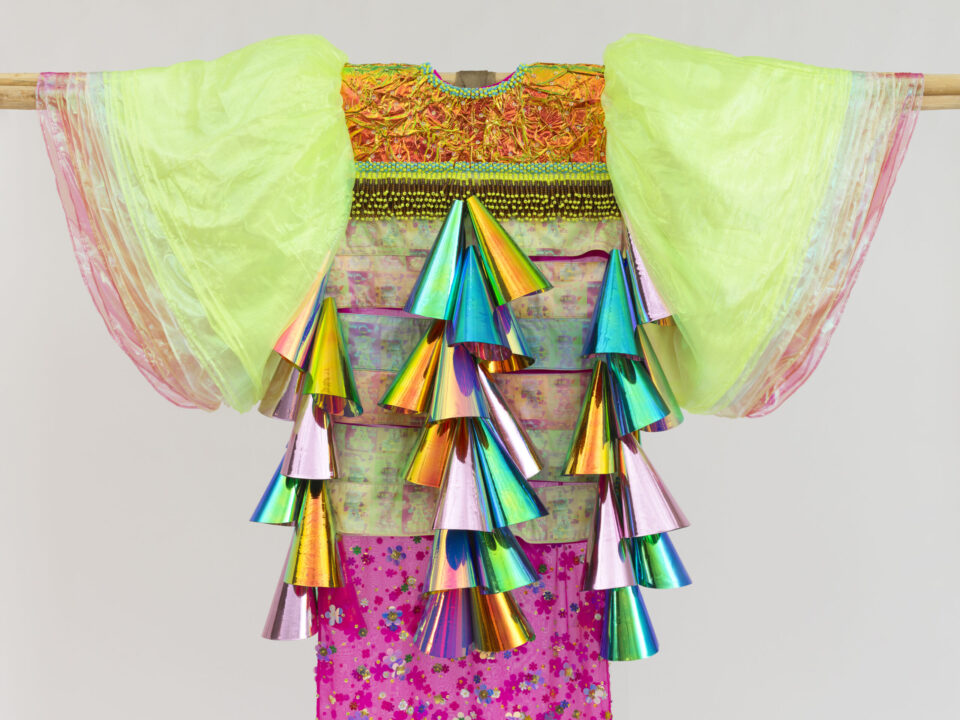
Washington has a joyful new reason to walk Pennsylvania Avenue. On October 27, the Irene and Richard Frary Gallery at the Hopkins Bloomberg Center opened Jeffrey Gibson: A Real Love Thing, a free exhibition celebrating a decade of work by one of the most acclaimed artists in the United States today — and it could not have arrived at a better moment, just as Native American Heritage Month begins.
Gibson, a member of the Mississippi Band of Choctaw Indians and of Cherokee descent, made history in 2024 as the first Indigenous artist to represent the United States with a solo exhibition at the Venice Biennale. In Washington, his vibrant practice across painting, sculpture, photography, printmaking and textiles fills the gallery with poetic text, song lyrics, bold pattern and rhythm. The show debuts a brand-new 2026 painting, All the things that led to this exact moment (Deep Blue), alongside the beaded, hand-dyed garment Don’t Make Me Over (2024), the wall cloak ANGEL OF MY SOUL DON’T LET ME GO (2025) and Keep On Moving (2019), the quilted banner that once welcomed visitors to the Whitney Biennial.
The title borrows its warmth from Washington-born soul icon Marvin Gaye, who said in a 1971 interview about What’s Going On: “I think I’ve got a real love thing going. I love people, I love life, and I love nature.” That spirit of beauty and compassion runs through the whole presentation, which even comes with its own playlist, curated by the Peabody Institute’s Michael Christie and available through the free Bloomberg Connects app.
On November 12, Gibson returns to the Bloomberg Center to deliver the fourth Sam Gilliam Lecture, a free public conversation on art, wellness and compassion with Melissa Walls, co-director of the Center for Indigenous Health. The exhibition runs through March 13, 2027, at 555 Pennsylvania Avenue NW, and the gallery is free and open to the public Tuesday through Saturday. Happy City News invites you to go fall in love with it.
Photo: Elisabeth Bernstein / © Jeffrey Gibson. Courtesy of the artist and Hauser & Wirth, via Johns Hopkins University